Showing posts with label Fiction. Show all posts

Tuesday, April 11, 2023

It's Still Cold and I'm Still Busy: What I Read in January, February, and March

Okay. So. Have I been a good blogger recently?

Well. Define "good." And "bad," while you're at it. 

Have I been an absent blogger recently? Well...

Barring a weekend sojourn to Canada for an eventful Spring Break touring around Victoria, BC, you don't really have any idea what I've been up to. You have no idea what I've been working on, and more importantly, you don't know what I've been reading.

So, I guess what I'm trying to say is, I'm sorry. I've been a... less than forthcoming blogger. But I've got a slew more posts coming your way over the course of this month, and I'm getting all of that other stuff handled as best I can. I mean, I haven't even been able to watch a single episode of Shadow and Bone Season 2 yet! That's how busy I've been! 

But for now, let's talk over everything I've been reading for the last few months. 

Well. Not everything. But a lot of it. Lay off, okay? 


january

Jane Eyre, Charlotte Bronte

A British Gothic classic, in which the penniless orphan Jane Eyre faces off against social expectations and religious doctrine while also battling feelings for her employer, Edward Rochester... amongst other things. A favorite of English teachers the world over. 

I had a massive hankering for investing myself in this thick and moody classic, since about October of last year. But because I was subsumed under so many different things, I kept pushing it off. I figured it was a good way to start off the new year instead: a hefty, but not insurmountable, reread, one that would allow me to have fun, while also being intentional about my reading habits in the new year. 

I knew I couldn't just throw myself into it without forethought, so instead, I used it as a kind of self-managed care practice: I'd be ready for bed by 10pm, read starting at 10:30pm, and after about three chapters, be tired enough to go to sleep. Not only was this a great habit to start forming, but it gave me a manageable, but not insignificant, chunk to break apart piece by piece. After almost two weeks of reading in this fashion, I successfully made it to the end! 

This was a reread that really made me feel my age... not in a bad way. I think I've really fallen into the habit over the years of reading solely for comfort, as a safe way to do some escaping - hence all the Romance and the novellas and the food writing - and not only did this impress on me the value of "difficult" books, but also, how far I've come since the first time I read it, in high school. A new appreciation for rich and dedicated description, as well as really effective word choice, and a retrospective understanding of a LOT of really effective foreshadowing. I also had a better critical perspective on elements of the more problematic or time-illuminated parts of the book, like the casual racism, or dedication to Christian dogma. 

Plus, I learned a ton of new words. 

All in all, I couldn't have picked a better book to kick off my year! 


Life with the Afterlife: 13 Truths I Learned About Ghosts, Amy Bruni

Television personality and veteran ghost-hunter Amy Bruni discusses growing up with an awareness of paranormal activity, her experiences in the field, and personal perspectives on hauntings she's encountered. 

Pretty close to the turn of the year, Mom and Dad decided that - like last year's sojourn to a local state park - Dad desperately needed to spend his birthday weekend somewhere fun. We ended up settling on Port Townsend: close to the water, packed with charming bookstores, and apparently, very, very haunted. 

Only an overnight, but still, I needed to be prepared. Dad had lent me this book back in December, when I still thought I'd be able to speed read my way through to Goodreads glory; instead, I read this across two days in January, in anticipation of staying in a haunted castle. 

I ended up enjoying myself! (With this read, definitely not the noisy, frustrating castle, which was occupied by both inconsiderate amateur ghost hunters, as well as a very large, very crunchy spider). 

Bruni was someone I grew up watching on Ghost Hunters, and my parents are still fans of her and Adam Berry's Kindred Spirits show. It was cool to read this in her voice (while also being able to tell, by its relatively detached and impersonal narrative, that it was definitely not her words alone).

While I loved her perspectives on being a part of the paranormal community and her details from producing both shows, the damper I felt was from my own personal feelings on hauntings: Bruni is a BELIEVER, to the point of having an entire chapter dedicated to her beliefs about aliens and Bigfoot. While I loved her views on the greater status of ghost-hunting shows as a sociocultural reflection, I couldn't quite commit to the same level of full faith that she clearly has. 


Also read: What a Dragon Should Know, G. A. Aiken, which you can find on another upcoming Paranormal Romance blog post! 


february

Hype: How Scammers, Grifters, and Con Artists Are Taking Over the Internet - And Why We're Following, Gabrielle Bluestone

An enthusiastic and detailed perspective on the failings of Fyre Fest, as well as the careers and ne'er-doings of other kinds of Internet-savvy fraudsters and falsifiers, like Elon Musk, Donald Trump, Caroline Calloway, and more. 

Thanks to our author's attorney background, this book is incredibly well-researched, footnoted to oblivion, and chock full of numerous, credible examples of wrong-doing perpetuated across the Internet and beyond. But because she is a human being who CARES, DAMMIT, parts of his book also carry the unmistakable tinge of emotion, and specifically, frustration: why the hell do these kinds of people keep getting away with it? 

So, well-researched? Yes. Well-composed? Not exactly. Chapters are long, and tend to wander down various tangential pathways when tied to other such credible stories; anecdotes are framed with significant bias and open feeling. In some ways, it kind of feels like Bluestone REALLY just wanted to include as much detail about Fyre Fest as possible, but was beaten to the punch by all of the other flashier coverage dedicated to the event, and her editors wanted her to widen her scope. In particular, the Covid chapter didn't feel organically tied to the overarching themes at all, but more like a publishing house request, as if her editor asked her to add an additional chapter after the first set of lockdowns hit. 

My overall takeaway from this book was that it was an entertaining, slightly horrifying read, and that all business majors should be placed on some kind of government watch list. 


Best American Food Writing 2020, ed. J. Kenji Lopez-Alt

A collection of some of the best short form food writing published in 2019, as selected by chef and Food Lab author J. Kenji Lopez-Alt. 

Truly one of my favorite installments, of a book series I've completely fallen in love with over the past few years. This particular edition occupies a strange place in time: all of the articles included in it were published in 2019, but the book itself was compiled and selected within the context of what was happening during the first few months of Covid. As a result, the context of various pieces feel somewhat suspended in time: post-Me-Too, but pre-George-Floyd-riots, pre-Door-Dash-dependency, but also at a time when its writers were completely oblivious to what trials the foot production, retail, and restaurant spaces would look like in less than a year. 

Personal favorite essays from this particular grouping: 

  • an exploration of the weaponization of grits in pop culture and relationships
  • a breakdown of the difficulties of simply eating at a restaurant as someone with a disability, and the ways restaurants could make their eateries more accessible to everyone
  • a pointed look at Lean Cuisine's marketing reliance on dieting culture, and their adaptation in the face of self-love movements
  • separate spotlights on the career dives of media-darling chefs Jamie Oliver and Rocco DiSpirito
  • a timeline of the targeted media destruction of New Coke
  • a structured and highly-scientific exploration of various supermarket ice cream brands, and where dollar prices make the most sense per consumer experience
  • a historical understanding of Prince's Hot Chicken in Nashville
  • truly the best and most realistic love letter to the cultural anomaly that is crab rangoon that I've ever read
Food lovers should already be reading this series, but if there was every any doubt on your end, start with this one. 


Also read: When a Scot Ties the Knot, by Tessa Dare, which you'll see on an upcoming Romance blogpost, and Bustin', which you'll see on an upcoming Paranormal Romance blogpost! 


march

Sixteen Ways to Defend a Walled City, K. J. Parker

In a fantasy world where pirates have invaded nearby cities and their locally stationed militia has been brutally taken out by a mysterious outside force, the fate of the empire hangs in the balance held by one single military engineer. The problem is, he barely has any idea as to what he's doing. 

Ugh. Can we all just talk about how disappointing it can be when a book turns out to be just... really problematic? Like if you could only excise out portions of the plot, dialogue, or characterization, everything would be fine. I felt the same way about Alan Bradley's questionable Fu Manchu section in The Bottom of the Pie, which colored my otherwise enthusiastic enjoyment of the book. "Just ignore all of these pages," you'd say, handing a book to a friend, "and everything will be fine." 

And then there's just the anger when you realize why that can't happen. When the problematic content is the driving force behind the main character, the antagonist's conflict, and the overall organization of the world. 

It's easy to be furious at the cruelty of the real world, where people are hideous to each other, where history lays forth in a gnarled and knotted tapestry, of all the ways pain can be inflicted. It's a different flavor of frustrating when confronted with an author who seems to have blindly, misdirectionally, confoundingly, decided to adopt elements of racial cruelty into a narrative, seemingly without considering any kind of an impact that inclusion of those inversions might have on their reader. 

But that's just part of the puzzle. This book could have been really good, and really funny... parts of it still are! But truly bonkers choices are made around world-building, characterization, plot development, and even the final 50 pages or so renders the point totally moot. 

It could have been better, but it wasn't. And I'm having a truly headache-inducing time questioning why the author made the choices he did. 


Across the Green Grass Fields (Wayward Children #6), Seanan McGuire

After fleeing a desperate situation of social upheaval when a confession to a friend goes wrong, Regan finds herself transported to the Hooflands, a wide-spanning world of only hoofed beasts, like centaurs, satyrs, and more. How will she find her way home... and does she even want to? 

I knew pretty quickly going into this installment of one of my all-time favorite Fantasy series, that this particular one wasn't going to be my favorite of the bunch. 

For starters, I didn't find the main character compelling; if anything, one of her first actions, and the subsequent few introductory chapters, mark her pretty squarely as a conformist, and a mean girl, in a situation where I feel like that wouldn't naturally be the case (she's a relatively well-off, middle-class child, who is demonstrated to have a decent social sphere and a natural intelligence and curiosity, with parents who are incredibly supportive and love her. So why shackle yourself to the meanest person you know, who will obviously one day betray you, who's already betrayed somebody else?). The choice seems to make more sense for plotting's sake, as the book that would naturally follow that kind of a character trait would create a plot driven by the idea of gaining worldly perspective, self-determination, and individual identity... but I don't really think those aspects were pulled off that authentically. 

The primary chapters caused additional confusion for me, as they clearly establish one of Reagan's crises of identity as being the revelation that she was born intersex. While it helps serve as a catalyst for primary action, it doesn't play a ton into the overall plot... and while I think that might have been the point of it - normalizing something that's already normal, that many people live knowing about themselves, but isn't really represented in culture or media - it makes for a kind of strange transitionary period at the end of the book. The narrative makes a point of referencing quite emphatically that sixteen years old will be the first time that Reagan has an opportunity to access gender affirming care, but - *spoiler alert* - when she is delivered back into the Real World at this meaningful age, at the end of the novella, it doesn't play into her realizations, inner dialogue, etc. at all. Which, again, maybe the normalization is a part of it, and maybe that kind of healthcare isn't referenced in the narrative because it's no longer something she cares about, but it still feels like it would be more meaningful if that was explicitly brought up. Instead, the plot point just kind of feels like it's left hanging. 

I'm not much of a horse girly, so the world of the Hooflands just really didn't appeal to me either. I felt like it was significantly less established or fleshed out than other worlds visited within the series. I thought it was a strange choice for a supporting standalone installment in the larger set. Apparently, Reagan will play a role in the plot of further books in the series, but for a first introduction, it felt like a weird, sideways kind of way to meet her. 

The major issue I had, though, was with the major theme or takeaway from the novel: that destiny doesn't matter, that you choose your own path, that you don't have to follow the lead that's handed to you. Reagan learns she can make her own choices, and stand on her own two feet, and that's great. The problem I have, though, is that "destiny isn't real" is a massively strange takeaway for a series of novels that are oriented around the sudden, unexplained appearances of magical doors that transport children to worlds in which major lessons are learned, only to then be thrust out of them again having learned their lessons. Destiny doesn't exist, predetermination isn't a factor... except for those big ol' honkin' doors, though. You should still believe in those. 

I've since learned from the Internet that Seanan is a huge My Little Pony fan, which at least explains something. 


Also read: Romancing Mr. Bridgerton and The Bromance Book Club, which will both be highlighted in an upcoming Romance blogpost. 


SO, that's everything I've read so far this year... almost. I've got a Romance blogpost coming up soon, about the - spoiler alert - disappointing Romances I've been encountering so far this year, and I've got another Paranormal Romance installment in the works, too, with some of my first picks from this year's Big Box of Paranormal Romance Challenge

What I'm saying is, stick around. Maybe I'll actually start posting regularly again. Wouldn't be the craziest thing to happen so far this year. 


What has been your favorite book of 2023 so far? Have you read any on this list? Let me know, in the comments below!

Friday, March 9, 2018

Review: Eleanor Oliphant is Completely Fine

31434883
I originally started reading this book because it had been chosen by my national sorority organization as a book club pick.... for the month of January. 

The idea that Sigma Kappas all over the world would be reading this book at the same time as me made it an alluring choice, which is probably why there were holds placed on it so heavily at my local library, that I wasn't able to pick it up until long after everyone else had finished reading it, on February 1st. Darn it!

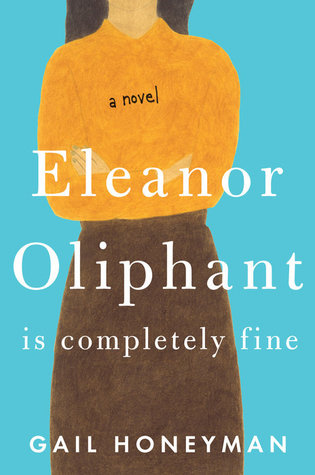
Eleanor Oliphant is Completely Fine, by Gail Honeyman, starts out with an assertion that is quickly proven to be anything but true. Eleanor Oliphant has been at the same desk job since she was 21, but does not feel the need to interact with her peers or move upwards on the company ladder at all. She abides by a strict schedule, which includes thrifty and solitary lunches, drinking vodka alone on weekends, and dreading the Wednesday night contact from her distant and controlling mother. And Eleanor would be more than content to lead that life for a long time... until an unexpected encounter involving a man from work, and an elderly man collapsing on a crosswalk, shows that life can be just as fine when lived with other people.

Enrapturing and enigmatic, I adored this book, despite not having any sort of anticipation of enjoying it built up beforehand. It's not that I don't like books chosen for me by other people, it's that I don't have exactly high estimations of book club books, especially when they're titles I've never heard of before, and doubly so when the blurb for it gives no hints as to what kind of story lies inside. In my opinion, neither the cover excerpts nor the front cover illustrations itself are all that indicative of the actual plot... the UK version does fare a little better, but I honestly don't believe you know what you're getting into until you read the first few pages. 

To be clear from the start, this rating is a high-ranking four, that is almost a five, because while I truly enjoyed this book and really found it enrapturing not just for its sense of mystery, but also the sense of empathy the narrative was able to elicit, it was just a little hard for me to read sometimes. That's probably why it took me a little over a week to finish reading it, even though every time I sat down to read it, I had a great time!

The book is fantastic at maintaining a sense of privacy and internality, while also building suspense and an aura of mystery around the main character... it's not easy to spend the whole narrative in the head of the lead, while still discovering things about her throughout the whole novel! While I think it's a bit of a stereotype for English majors to enjoy reading things with unreliable narrators, there's this unique sense about Eleanor that she's not trying to deliberately hide or obscure anything, it's that there's so much she's not willing to accept. You can maintain empathy and a sense of introversion with the narration, while also understanding that you are limited by Eleanor's own lack of understanding.

It's that kind of balance between self-effacing objectivity - from the somewhat silly, like how our main character doesn't know what Spongebob Squarepants or a bikini wax is, to greater patterns of not understanding most normal cues of social interaction - and a deep sense of personal incomprehension that perform a delicate balancing act in keeping the narrative going. Eleanor doesn't know much about the world, but she doesn't know much about herself either, despite carrying on with a self-assured confidence that can't help but serve as an ironic point of humor.

In some ways, that's what made the book difficult to read. Reading people make inappropriate comments or behave improperly in social situations is always a turn-off for me... it's one of the reasons why I hated my family's fixation with The Office when I was younger: that kind of humor just isn't funny. It's painful. However, it wasn't just that it was supposed to be funny that Eleanor found herself in these kinds of situations... it was to demonstrate a significant point of discrepancy between Eleanor's ability to operate as a person in the world, against her perceived ability to occupy it.

The novel deals with depression and PTSD in a frank and open way that I think is not only highly commendable, but incredibly well-informed. The depictions of casual alcoholism hit uncomfortably close for someone who also has a strained relationship with drinking. Both brought me to tears more than once, and by the end, got me actively begging out loud for Eleanor to go get some help. It wasn't just because anyone could recognize that she had problems... it was that you really wanted her to get better. You can't help - despite all of her intensely awkward mannerisms - but really love her by the end of the book.

Side note: I was absolutely terrified it was going to turn into a romance - especially due to the book's packaging - and felt absolutely vindicated when it did not. Sorry if that's a spoiler, but if you're someone like me, maybe it will convince you to give this book a chance.

Especially because I almost didn't! Like I mentioned at the start of the review, I think it has a horrendously ugly cover - if you're buying the US edition - and not the most inspiring blurb on the back. That's not the story's fault, though... you really can't get a sense of the book without peeking inside it. (Just like with Eleanor, herself!) Give it a few pages, and then make up your mind. Though I will tell you, I hope you read it.

Final Verdict: An unexpected favorite, with a unique main character and sense of deep emotional connection. If I had to choose two words to describe it, I would say "humorous" and "heroic"... not only is the book quite light-hearted in most places, but its main character is both endearing beyond her foibles, as well as uniquely strong and resilient in her own right.


Have you ever been a part of a book club? What's been a recent unexpected favorite of yours? Let me know, in the comments below!
Wednesday, January 25, 2017

Feed : A Review (+ a Library Challenge!)

169756
It's funny to see just how much this blog has changed in the 6+ years I've been writing it... for instance, for the first couple of years, it was exclusively book reviews of the fiction I was reading, but now, I haven't posted an individual, in-depth review of a "made-up" book since last year! 

To be perfectly honest, there's no book I would rather have as my first serious take on critical fiction reading for 2017, especially because this socially-aware science fiction literary hit seems a little uncomfortably prescient for the coming years.

And fair warning: it's a bit of a long one. 

I was taken as soon as I saw the cheerful signage on display near the "Recent Releases" caddy in the YA section of my local library. "... Do you believe in love at first line?" 

To be fair, I'm crazy about these kinds of challenges, in general. They rarely go my way - both my "Blind Date with a Book" choices so far have ended up being DNFs - but the sheer novelty of being forced to step out of your comfort zone is too enticing of a challenge to ignore.

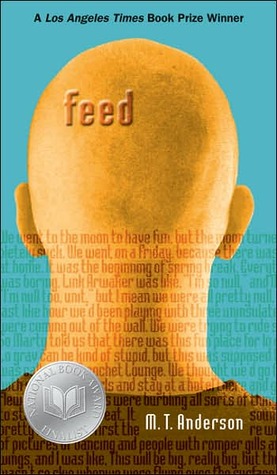
I chose this sentence because it seemed whimsical enough: "We went to the moon to have fun, but the moon turned out to completely suck." Unfortunately, as soon as I opened the newspaper wrapping, my heart sunk.

M.T. Anderson's Feed. I had never heard of it before, but it had won a National Book Award. The cover seemed very 2000s, with bright orange-and-teal coloring and an off-putting bald head, superimposed with lines of text in a cheesy font. I considered simply sticking the book back in my library bag to return on my next excursion... but then again, Mama didn't raise no quitter. I knew I had to give the book its chance. 

Unfortunately, it wasn't an easy go, at first. The book starts off so Jetsons-type science fiction that it completely threw me off. I mean, they go to the moon on vacation, and take part in zero-gravity dance parties. They have hover-cars and live in bubble-surrounded suburbs. The government is no longer willing to pay for public education, so corporations do it instead, raising children to point and buy since birth, and babies themselves are manufactured in hygienic conceptionariums in front of their parents, because having birth "freestyle" isn't doable anymore because the effect of all the ambient radiation. 

Wait, what? 

Once the book hits its stride, it becomes obvious that this particular space romp is way more Black Mirror than Futurama. While you're tempted to initially write off the plot as some kind of "Teenz in Space 3000" - complete with hip lunar lingo and fashion trends that update multiple times a day - it all comes crashing down, literally, when a hacker at a lunar club infiltrates the teens' feeds - the mental brain implants that connect them with the world, in the same way our cell phones do - damaging their hardware, and sending them into medical quarantine.

Here's the thing: the book isn't about them realizing the errors of their way of life, then rebelling and overthrowing the damaging American corporation-based government, like most contemporary YA would see them do. It's them learning to live and attempt to move on after being forcibly separated with the tech they depend on for not only entertainment, but commerce, news, and essentially, life capital.

This division - particularly for our narrator, Titus, and the odd-girl-out Violet - forces them to confront the shallowness of the world they live in, but not necessarily in a way that prompts them to reject it. This event is a disruption in a seemingly idyllic life, that serves as a sledgehammer to the narrow screens of filtration that keep all the strange and uncomfortable parts of that life out.

It  especially throws into sharp relief the lengths people will go to, to distract themselves when the situation gets too horrifying and dangerous to ignore. Instead of fighting back and rallying against the destruction around them, Titus and his friends are content to spend their time analyzing reality television, buying into the newest trends, and moving on from the uncomfortable memories of their attack. While Violet is growing increasingly more aware of the troubles they face - like the lesions sprouting out across everyone's skin for no reason - Titus' parents reward him for his bravery in overcoming the lunar incident by buying him a new car.

Despite the ambivalence of the teenagers, the book isn't anti-Millenial, either. The world isn't dying from Instagram overload; the problems they face are due to previously existing constructs, like a failing governmental system that doesn't take accountability, over-integration of corporate interests into the lifestyles of the general public - especially in areas like Education and Healthcare - and a widening disregard for our relationships with not just foreign interests, but our own low-income populations, as well.

(Hmm... this dystopian world is starting to sound a little familiar.)

I'm almost glad that the book is more focused on the world around them than the teens themselves, because the world-building in this novel is truly the exceptional part. The feed is an extension of your brain, and instead of taking drugs, you download malware - for a price - from European entities to short you out, instead. As you walk through the mall, you are bombarded with advertisements and alluring promises of coolness from each of the stores you walk past. Entertainment has degenerated into familiar plot structures with more and more outlandish elements that get rotated out, alongside their overused, simplistic dialogue and characters. Press is virtually nonexistent, and the only stories anyone knows how to tell are "a sentence long." 

My personal favorite image - and one that has stuck with me since finishing the book about two weeks ago - was the idea of factory farms growing to the extreme: instead of mass manufacturing cows for beef, they cut out the middleman - middlecow? - and manufacture tissue instead, directly across mile-long fields of sanitized, plastic-wrapped farmland. Terrifyingly, errors in the genetic coding used to clone this tissue show up in the form of eyes, bones, and even hearts, generated across the clear expanses of living muscle. 

In fact, the world was such a vividly-drawn and startlingly realistic one, that I wanted to include lots of quotes for verification, but would have put half the book in one blog post. For instance, in one section, Andersen describes the ways how the corporate interests integrated into the feed work, narrowing social experience to a small segment of identifiable and replicable viewpoints, dictating the whole national culture, that so completely encompassed the ways social media ad algorithms work on Facebook, that I had to put the book down and walk away. 

In some cases, the cultural connections are so completely on target, that the black humor is somehow tinged even darker. For instance, one day, Titus and Violet arrive to meet their friends, when they see them all covered in bloody, torn clothing. As they express their distress, their group laughs at their surprise: "Riot Gear" is the newest, hottest trend! I mean, it's all over the feed. One girl, Quendy, even happily models her new clogs, dubbed the "Stonewall" style, but expresses disappointment in their fit: these women's shoes seem to be sized for men.

Once I read that section, I think my eyebrows climbed all the way up into my hairline. It's a bold joke to make. However, it also draws a startling comparison to the Urban Outfitters scandal of Fall 2014, when the trendy retailer's catalog offered a hole-ridden Kent State sweatshirt, covered in daubs of red fabric dye that gave the appearance of sprays of blood. The "vintage"-style $129 sweatshirt was deemed too uncomfortably reminiscent of the 1970 Kent State Massacre, and was ultimately pulled from stores. (Soon after, it gained a lowbrow collector's status on websites like eBay.)

All of these somewhat uncomfortably realistic portrayals of culture, corporate interests, and the American way of life, give greater context to my favorite part of discovering this novel: I was right about its 2000-era status. In fact, this book - with its expert portrayals of social media, personal tech, ad algorithms, and strangely familiar idea of what the end of the world looks like - was written almost 15 years ago, in 2002.


Final Verdict: This book instilled in me the kind of sci-fi nerd love I haven't felt since I read Rodman Philbrick's The Last Book in the Universe for the first time in middle school. It's early-2000s status only amplifies its dystopian message, and it's connections to contemporary culture make it  enthralling. I get the feeling that it's a great time to be consuming apocalyptic science fiction.


What's your favorite dystopian science fiction pick? Would you ever read a book like Feed... or would you prefer to stick to the nightly news, instead? Let me know, in the comments below!