Wednesday, July 13, 2016

Bits of Books: Callie is a Godsend and Lends Me Stuff


It's definitely not the first time I've mentioned Callie - my onetime Student Calling Center manager and current favorite book lending person I know - and it's certainly not going to be the last: Out of the eleven books I've read so far this summer, three of them are the result of a very generous book swap, courtesy of her! 

Subsequent to giggling our way through the newest Jane Austen adaptation Love & Friendship last month, we swung by her house, and after a very cute room tour, she loaded me up with three titles I'd not yet read, and sent me on my merry way. Being that we're trying to get together for coffee on Friday morning, I figured that it was a good enough time to finally upload all my impressions of those books she lent: A Court of Mist and Fury, East, and Rebel Belle! 


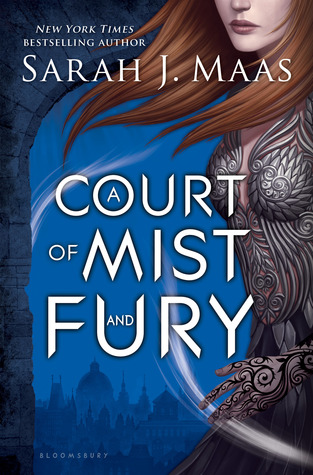
a court of mist and fury, sj maas
17927395
The sequel to Maas' A Court of Thorns and Roses, the story follows Feyre adapting to her new life as a member of the High Fae. Unable to cope with what had befallen her Under the Mountain, nor feeling as connected to the Spring Court as she once had, Feyre begins to discover the truth about her newfound powers, though it may require Rhysand, High Lord of Night Court, to help her really harness them. 

Callie originally proposed this read to me in our English class this past Spring Quarter, with the tagline, "It's so much better than the first one!" She and I had both read the original, and found it to be severely lacking on a pretty spectacular scale, so the fact that she braved it and committed to reading the second one was really enough for me to do the same. And, of course, she was right. 

Almost all of the problems I had with the original were remediated and resolved in the sequel... originally fractional world-building got a massive expansion as Feyre visited some of the other Courts, underdeveloped characters got the in-depth treatment with more involved relationships and backstories, and an uninspiring cast got an exciting update via some of the newest perspectives on the Night Court. It's impossible to list all of the reasons this book was such a dramatic improvement without spoiling the whole thing, but damn. Thank goodness for Callie's stubborn need to follow through with a series.


east, edith pattou


Despite her superstitious mother's attempts to conceal the truth of her birth, Rose has always been the adventurous and troublesome type. However, even she couldn't predict the sudden trouble  of a giant white bear showing up on their doorstep, promising to save her sister and recover the family from ruin, only if Rose should come with him. What she finds through her journeys shows her there's more to the world than what's covered on her father's maps, and magic is more than possible.

Basically, it's a like a Norwegian variation on the Beauty and the Beast story, utilizing aspects of that particular country's fairy tales, while also exploring various aspects of other parts of Europe. For Callie, this book was one of her middle grade favorites - enough to still keep it on her collegiate bookshelves - and fed into a deep love of fairy tales from all over the world. Being that the latter is one of the many things we have in common, I was excited to explore this read.

The book is truly based off the tale "East of the Sun, West of the Moon," a Norwegian fairy tale that does bear great resemblance to both the Cupid and Psyche mythology and the best Disney animated movie of my youth. In terms of adaptations of classic stories that still manage to differentiate themselves from the original mythology, this is an incredibly effective variation on the  narrative, with unique cultural differences providing for new opportunities to build out the story even further. While retellings can often be a miss for me - I still feel like I'm one of the only book bloggers who really doesn't like Tiger Lily - this was incredibly unique to the genre, and I think that has a lot to do with its heritage. 


rebel belle, rachel hawkins
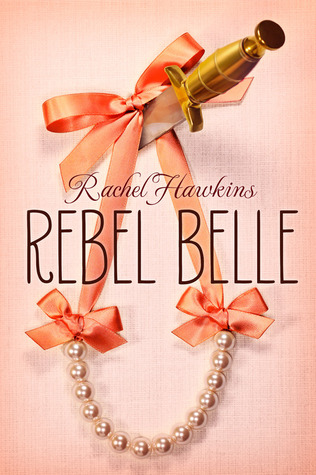
After high school wunderkind - head cheerleader, ASB president, Homecoming Queen, debutante, and more - Harper Price encounters a strange fight between two teachers in the school bathroom, she finds herself wielding more power than just what the high school social strata would normally allow. Able to perform martial arts and exert a strength she's never had before, she finds herself taking on the additional role of "paladin" beyond her extensive after-school schedule... tasked with protecting the "oracle:" her high school nemesis, David Stark.

I typically scoff at contemporaries, and Callie knows as much, but it didn't stop her from attempting to get me to read this book. While I initially demurred, and left it to the end of the list for my planned reads, I eventually gave in, knowing that it would only be an afternoon's work to finish and would help bump up my Goodreads Challenge tally.

I was right: it was an enjoyable afternoon's read, one that had me laughing at the right moments and left me engrossed in the action when I needed to be. While some parts were a little cringe-y - I would pay YA contemporary authors not to try and describe fashion - they were easy to ignore once you'd figured out that the entire novel is basically a variation on some kind of Buffy the Vampire Slayer episode. Not that bad... though Callie has warned me against continuing farther in the series, being that the sequel's not that good, either. All in all, it was exactly what I had expected it to be.


So there you have it! Thank you to Callie for letting me borrow her books; I took care of them just like I said. Maybe I'll have to do another post once she finishes up the novels I'm lending to her on Friday: John Connolly's The Book of Lost Things, Steve Augarde's The Various, and Naomi Novik's Uprooted!


Do you have a book lending habit? Have you read any of the books mentioned? Let me know, in the comments below!

Friday, July 8, 2016

Time is a Goon: Revisiting Jennifer Egan's 'A Visit from the Goon Squad'


When I was younger, I wanted to get a tattoo of a book quote. Well, that's an incorrect statement... I wanted to get many tattoos of books quotes, endless ink snaking around my skin like an  unsolvable riddle, as if somehow the act of printing words onto my physical person could turn me into a book, myself. Then I grew up, and after one too many chastisements from my disapproving mother, the foreshadowed terror of sagging skin and warped ink proved to be a suitable deterrent for my extreme bibliophilia (at least, in terms of my own attempt at transfiguration). I haven't really been tempted by the concept since.

Until, standing in my kitchen yesterday, waiting for tea to steep, when I read the words "Time is a goon." The act was immediately followed by the thought, "I need a tattoo of that."

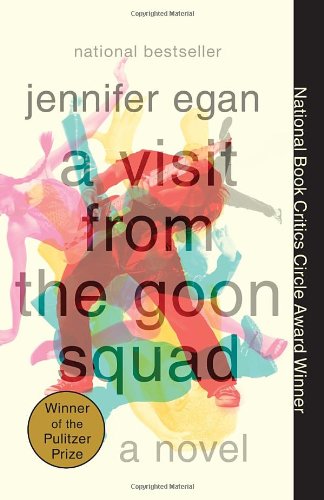
The sentence comes from the acclaimed Jennifer Egan novel A Visit from the Goon Squad, which won the 2011 Pulitzer (as well as many other accolades, as if you clutched a fistful of gold-starred darts and overhanded them at a list of the world's top publishing achievements). It also formed the basis for my first-ever college-level English experience: my ENGL 111 class. An integral part of my Freshman Fall Quarter, the novel would become the best work I read in the whole of that year, and one that prompted one of the greatest author obsessions of my reading life.

I remember having classes on the second-floor of Bagley, UW's Chemistry building, located 20 walking minutes away, and becoming acquainted with our esteemed institution's overt apathy towards most Humanities programs. Our teacher was a graduate student whose disinterest in the question of us learning anything that Quarter, lead us to follow up Goon Squad with Jay Z's expletive-laced memoirs, then didn't allow us to use such language in class discussions or papers. I made friends in that class who, funnily enough, would go on to help define my Greek experience, as well as my scholarly one, and also gave me my first glimpse at my already-determined future as an English major.

While wandering through my bookshelf on a recent trip home, I saw my copy of A Visit from the Goon Squad wedged between my other Egan novels, and the title alone was enough to prompt me to a reread. Afterwards, I stumbled across the partial review of what I had written the first time 'round. I was fairly impressed with my description:
Instead of following a linear or chronological pattern when discussing [the novel's characters], Egan threads their stories together across the boundaries of time, traversing months, days, years and decades, to explore exactly how this seemingly unrelated cast came together. It's as if the entire book is a love letter to those six degrees that separate us from Kevin Bacon. It reinforces each of those chain links between us, that we may take for granted, and reminds us that strangers - or employees and bosses, girlfriends and one night stands, husbands and brothers and especially terrible fathers - may end up mattering more to us than we think, and we may still matter more to them.

In other words, if there was ever a book to remind you that every person you pass on the street has a past, a story, a family, a best friend, and especially a future, it's this one.
Rereading the complete post,  I was struck by how Freshman Savannah defined the work as an inherently hopeful one, as something that prompted outwards reflection, particularly in regards to the interconnections of the human community, the absence of moral absolutism, and most particularly, the idealism of hope. 

What was thrown into sharpest relief in that review, upon completing the reread, was the amount I didn't include. Themes of materialism, death (overcoming, succumbing, and bringing it about yourself), and ambition are ignored in the review, in favor of preaching kumbaya, which, of course, makes sense when you consider the mindset I was in when I was writing it: a scared freshman on the brink of four years of scholarship, what I needed to take away from the book was a sense of being less alone. 

(Then again, I wasn't wrong: flow chart artist Gillian James, of Tessie Girl, made this flowchart of Goon Squad characters back in 2013, and it's still not wholly representative!)

Now, as Senior Savannah, it's unsurprising that what strikes me the most about Goon Squad, is the malleability and consequentualitism of time. The nearly-nonexistent temporal delineations that once struck me as a device used to illustrate the power of meaningful human relationships, instead impress upon me distinct purpose: the whole is constructed on the foundation of the piece, the day is defined by its consequence in the ensuing year. The moment is catalyst, the rest is figuring out what that moment meant, and means.

The point is, that the point can be meaningful: plenty can happen in the years before, between, and coming, but it's preserving that moment that marks the difference. Each chapter forms a puzzle piece that, yes, casts a spotlight at a character and community, but they also illustrate realities of emotion, action, and change, on a definable scale. Yet, it's not just the individual chapters that make the book notable, but the entirety of it, just like it's not just one emotion, thought, or action that is most important, but the way they're all strung together.

Your best days and your worst days construct a complete and meaningful life; it's not Freshman Savannah in the act of reviewing a book or Senior Savannah in the act of reflecting on it, it's the inferred four years of experience, opportunity, and learning, dividing the two, that make them both so meaningful. You don't remember the number of books you've read, or the hours you spent confined in class, or the amounts of Diet Coke (and not Diet Coke) you drank during Finals Week... those are all the flotsam and jetsam that fill up the empty spaces of your life, but they're not the moments that truly build it.

Time is a goon - a bully, and a thug - but it's the collection of individual moments you're left with when the years are stripped away, the snapshot Polaroids of complete captured self that you string together into a story, that show the impact and importance of the whole thing.

I can't tell you all how happy I am that I decided to pick up this book again.


What book defined your college experience? If you could reread any book right now, what would it be? Let me know, in the comments below!
Tuesday, June 28, 2016

Capstone Lite: The Paper that Allowed Me to Graduate, Abridged


In a perfect world, this post would have gone up sometime shortly after the last day of my Capstone class... sometime around the 9th. Unfortunately, the world is not perfect - my bookshelves never have enough room and Trader Joe's meringue cookies don't automatically reappear in my pantry when I empty the box - and most of the time since I've officially graduate on the 11th has been spent attempting to reclaim some semblance of the sanity I completely lost during Spring Quarter!

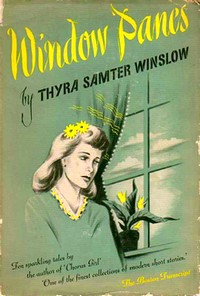
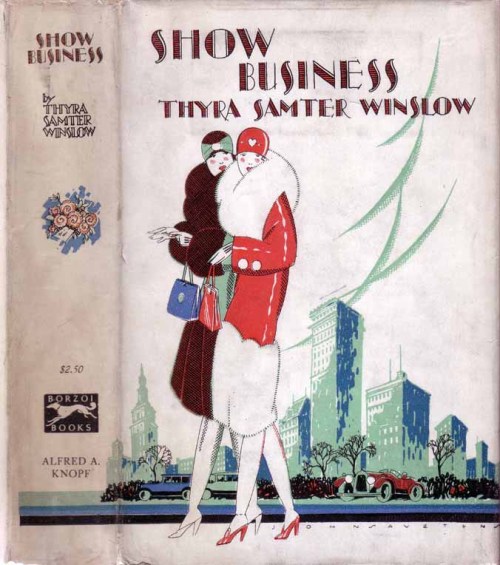
However, I worked way too hard on my 15-page graduation-earning research paper and got way too good of a score not to brag about it here, especially because the topic I was taking on grew to be way too dear to my heart. No one in my entire class had ever heard of Thyra Samter Winslow - including my professor! - before I started my literary explorations, and yet I fell head-over-heels for her through weeks of research, and I already know that its only the beginning of a continuing obsession.

Of course, I'm never one to be selfish, so I'm sharing all this beautiful and interesting information with you!


tracking T.S.W. 


So, who, exactly, is Thyra Samter Winslow? She was a prolific magazine author, who wrote for numerous New York magazines between the years of 1915 to 1955, with more than 200 titles under her name. She wrote screenplays during the Golden Age of Hollywood, and television scripts at the time when the medium was only first starting to be developed, and on top of all that, managed to publish several books, as well.

However, not a lot of that information is available online, unless you know how to look for it: Thyra Samter Winslow, despite the amounts of work she wrote for a diverse range of mediums, does not have a Wikipedia page. What she does have, are a spot in the Jewish Women's Archive, the Encyclopedia of Arkansas, and, thankfully, a firm foothold in the online Modernist Journals Project.


modernist matron of the magazines


The Modernist Journals Project is a joint project of Brown University and the University of Tulsa, and was the main focus of my research in the past year. What you'll find on the website are thousands of magazines printed during the modernist era, scanned and uploaded for your reading pleasure, and boy, was I pleased with it. By far, my favorite magazine was The Smart Set - a satirical skewering of the social sets of New York, written by some of the time period's best, and published monthly - and it was by exploring that work specifically that I stumbled upon T.S.W. completely by accident. 

It was really only a matter of time before I found her, as she published a total of 59 articles in the nine years of that magazine that are chronicled in the database. As it turns out, the objectives of the magazine and her own writing style enmeshed almost completely, and she was easily able to fill the bill of humorous poems, vignettes, short stories, and novellas humorously centering around the lives of society's boldest and brightest. 

However, what I appreciated most about her writing, was how she always made sure to center her stories around the characters she wrote best: young women working in the big city, as showgirls, secretaries, stenographers, and socialites. Her perspectives on the status of the modernist New Woman - independent, sexually active, and ambitious for a better life - are among the best I've ever read, and it was her marriage of rib-tickling satire with bigger social ideas that made her such a benefit to the magazine. 


T.S.W. recommended reading

It would be horrendous of me to talk so glowingly of an author's work, without providing you with the opportunity to explore some of it for yourself, as well, so here are a couple of my favorites:  

"The Best," a novella - Sylvia flees the claustrophobia of a small town for the showgirl lifestyle in New York, only to get married to a rich man and move back to a life in the suburbs. Feeling cramped again in her new environment, she is forced to consider where she really had "the best" years of her life: free and in New York, or secure in a small town? 

  • Why you should read it: the basis for the entire line of inquiry in my Capstone, this story highlights several of T.S.W.'s favorite themes, including the disparities between small town and big city life, the status of the working girl, and factors in her trademark ambiguous ending, where the reader is prompted to consider the moral dilemma at hand without a truly happy outcome.

"Little Emma," a short story - Emma escapes small town life for Chicago, and is desperate to remain in the city for as long as possible. Attempting to use her backstory to find a job - and a rich boss to seduce - she quickly realizes that she is too modern to play the part well, prompting an epic make-under, and a secured position as a secretary. However, her ploys work too well, and force the moral question of continuing the fabrication she's succeeding with, or going back to the modern persona she'd strived so long for? 

  • Why you should read it: providing yet more examples of the same themes we'd seen in "The Best," this story satirically profiles the idea of a "country girl" peddled by the 15 cent magazine story en vogue at the time, and how she can inevitably find success in the city. It's incredibly funny, but also provides my favorite ambiguous ending out of Winslow's entire body of work. 

"The Proper Thing," a short story - The social set of a Floridian winter resort for the wealthy and elite is turned upside down with the arrival of a new girl, perfect and proper in every way. Initially welcoming and curious, they are inevitably put off by her complete perfection, and the only gentlemen at the resort worthy enough of earning her favor is yet another completely, off-puttingly perfect person, a gentlemen who is similarly inscrutable. Together, this infuriatingly ideal couple seems to have come straight out of a romance novel... and it turns out, they have! 

  • Why you should read it: out of the entirety of Winslow's canon that I managed to cover during my short time with research, this was my absolute favorite! It breaks from some of her favorite themes and topics, in order to more accurately skewer the rich and frivolous, providing one of my all-time favorite excerpts from her work: an explanation of the inverse relationship between how well you play tennis and how well you dress for tennis, as being an indicator of whether you were Old or New Money. 


why this all matters so much to modernist literature  (& me!) 


So, as you might have been able to tell from the above explanations, Thyra Samter Winslow was not only a very accomplished author, but a very under-represented one, especially when it comes to what we read from the era nowadays. She should be sharing shelf-space with the like-minded reprints of Dorothy Parker and Anita Loos, but to be perfectly honest, I think her writing has a lot more in common with some of the romance and chick lit authors who came so many years later, as well.

I made my professor laugh when, during a presentation, I referred to her as "a Modernist Nora Ephron," but I stand by my comparison: T.S.W. wrote fearlessly about women - women's issues, women's places in social circles and career fields, women's relationships with men and sisterhoods with other women - at a time when that was only recently becoming an acceptable thing to focus on, and she did so in a way that was compelling, engaging, and more than anything, while still being funny and relatable.


the outcome


And so, with a lot of hard work and late-night synthesizing sessions, my paper was completed and turned in, earning itself a very cool 3.9! (I lost points for getting a little too excited about the topic to provide a comprehensive sense of organization, as well as going a page over limit.) I couldn't be happier with how I did in the class, and am proud to have
earned not just that grade, but also a new favorite author to collect in the future!


Had you ever heard of Thyra Samter Winslow? What bookish topics and genres do you like exploring? Let me know, in the comments below!

Thursday, June 16, 2016

Love and Friendship: Why Austen and Non-Austen Fans Alike Will Love this Movie


This past week, I was lucky enough to convince my friend Callie - She Who Lends Books, as well as enjoys Austen adaptations just as much, if not, somehow, more, than I do - to come with me to a screening of the newest inductee into that particular club, Love & Friendship, at Sundance Cinema, just a stone's throw away from the Ave. I had first informed her of the movie back when we were taking an English class together Spring Quarter (in which we both got 4.0s, thankyouverymuch), and she had heard of a deal that allowed us to get tickets for only $6, so we made a ladies night of it!

I had been somewhat trepidacious of the film when I had first watched the trailer back in January, mainly because I already recognized the title: while the trailer billed it as "Jane Austen's Comic Gem," it's actually one of her works of juvenalia, written when she was just a teenager, and is widely unread in comparison to her classic novels. More deceptive still, the movie itself is actually based on a different work of Austen juvenalia, titled Lady Susan, a novel that is even less likely to have been read or published! I was worried it was just an attempt at cashing in on a famous name for the sake of a half-made period movie, and the title swaps did nothing to persuade me to think otherwise.

Which means I was completely unprepared for the fact that I'd be laughing every three lines the actors managed to deliver, and would frequently be looking to Callie, only to see her giggling, too. It was easy for us Austen fans to love this film, but as it went on, and we were confronted with not just witty one-liners, funny faux pas, and even modern directions of comedy taking place on screen, I became thoroughly convinced that anyone could love this movie.


for the die-hard Darcy lovers... 

If you love Jane Austen, obviously you are going to love the fact that Austen wrote it. However, beyond even that basic element, there's plenty to be enjoyed, like historical elements and antique social graces. 

The filming locations and the outfits are probably one of the most prominent things to drool over, for fans of the Austen era: as soon as the movie got out, Callie and I started for home by ranking some of our best and worst looks for the characters (keep an eye out for a particularly iffy pink-and-blue getup worn by Kate Beckinsale's Lady Susan around the movie's halfway point!). But oh, all that sumptuous velvet and embroidered lace, all those bustles and petticoats and everything else! I, for one, petition to bring back the popularity of incredibly stylish lace headbands. 

Additionally, the comments made about the time period - both directly and indirectly - deliver some of the film's most subtle funny moments, too. For instance, those in the know about England's dietary foundations know that peas are a substantially important produce for the area, which makes the foppish and idiotic Sir James Martin look even more the fool at his astoundment over the peas on his plate ("Novelty vegetables!"). Even Lady Susan's interactions with her best friend, Alicia Johnson - played by deadpan Chloe Sevigny - over threats made by the latter's husband to send her back to Connecticut, are riotous, based on Susan's complete condescension of the United States. It's these kinds of moments that really impress those who love the classics. 

for the casual comedy fans... 

Don't be turned off by the fact that this has every outward appearance of a period piece; the proliferation of modern funny moments throughout the film, as well as the stellar comedic performances by some of the film's main actors, make the production an inherently hilarious one. 

The modern elements of the film's production that utilize more timely humor are some of the most interesting stylistic choices, as well. For instance, the integration of typeface that appears on screen when characters do things like read letters or poetry, is a purely contemporary kind of humor, one made unique by the medium. Additionally, one of my favorite parts of the movie was the way it introduced the characters: through type of their name and brief character description appearing beneath their faces, often to hilarious effect. 

The highlight of why this film would appeal to even those who don't like Austen, are the comedic performances by some of the film's most ridiculous characters. Cringe-worthy conversations with the aforementioned Sir James Martin, and the hysterical Lady Manwaring, both made for entertaining moments that reminded me a lot of ludicrous performances you'd see on television, like on The Office. These modern perspectives of humor did a lot to freshen up the film's overall aesthetic, as well as appeal to viewers beyond the witticisms of its Austen origins. 


In summary, while the adaptation itself doesn't truly hold through as an Austen classic like some of her big- and small-screen novel adaptations due, it's an incredibly fun and funny film that will definitely appeal to Austen fans, but also those who might not love her other works... just in case you needed a friend to go see it with you. 


Have you seen, or are planning on seeing, Love and Friendship? What's your favorite Austen adaptation? Let me know, in the comments below!

Monday, June 13, 2016

End-of-Quarter Book Haul, Spring Edition!


It was only after I'd officially been on Summer Vacation for about a day, on Friday, before I realized that since it was the end of the Quarter, that meant, inevitably, that the University Bookstore would be having its end-of-Quarter sale! 

Despite having a bit of a reader's slump recently as I finished my Capstone, and feeling a bit in flux due to unsettled feelings about one of my required classes - more on that in a different post - I knew that getting a couple new titles in my hands would help perk me right back up. Besides, I knew that the books that I'd bought at the end of Winter Quarter had been incredibly cheap for what great books they were (despite the fact that I still haven't read any of them yet... oops. Thank goodness it's summer!). 

Anyways, not only did I make the trip myself, but after only spending half an hour in the store with my sister, I made a return visit that same afternoon with my friend Taylor, just to do another lap around, and make sure I hadn't missed anything! Here's what I picked up: 


trip one


1. Emerald City, a collection of short stories, Jennifer Egan
One of the two books I simply grabbed with the immediate thought of "Yup, you're leaving here with me," this book is the product of one of my favorite authors in the whole world, who I've also been hoping to reread. 

2. Contested Will: Who Wrote Shakespeare?, James Shapiro
The second of those two books, this nonfiction breakdown of the validity of some of the most prominent Shakespearean conspiracy theories is divided by section into the most likely candidates for who really wrote the Bard's canon, then sets about debunking them. 

3. Passionate Minds: Women Rewriting the World, Claudia Roth Pierpont
This Finalist for the Nat'l Book Critics Circle Award for Criticism profiles the lives of different women writers like Gertrude Stein, Ayn Rand, Margaret Mitchell and Zora Neale Hurston, and emphasizes the contributions of their work in relation to politics, pop culture, and, of course, literature. 

4. Memoir: A History, Ben Yagoda
In what is almost the most Savannah-type move ever, I immediately loved the idea of a book specifically documenting the history of memoirs. The cover is gorgeous, too! 

5. The Amazing Adventures of Kavalier and Clay, Michael Chabon
Recommended to me by several people, this Pulitzer Prize winner is an iconic fictional account of two men at the turn of the '40s, cashing in on the craze for comic books by creating their own.  


trip two

1. The Taming of the Shrew, William Shakespeare
Not only is it the basis for two of my favorite Shakespearean adaptations ever created - the musical Kiss Me, Kate and the seminal teen movie classic, 10 Things I Hate About You - but it's also from my favorite line of editions: the Folger Shakespeare Library. 

2. The Warrior Queens: The Legends and the Lives of Women Who Have Lead their Nations in War, Antonia Fraser
I recognized the name of the author almost immediately, having written Marie Antoinette: The Journey, and figured I'd at least glance through it, and was quickly convinced I had to buy this book! 


During Trip One, while I had been settling into the floor to reach the way-down-low shelves, my sister was bored and roaming the general tables, and she picked me up a copy of "Summer Book Bingo 2016": hosted by the Seattle Public Library, and in partnership with independent bookstores around Seattle - including Elliot Bay Book Co! - this bingo and blackout board is populated with various genres, sources, and general themes for books to read, like  "Recommended by a Librarian" and "Finished Reading in a Day." Once you're done, you can post the sheet on Instagram with the event hashtags, or send it in, in order to be entered to win prizes, like a $30 gift card to a participating Seattle-area bookstore, or even the grand prize of a curated library set from Seattle Arts & Lectures authors!

Needless to stay, I'm excited. Delaney somehow managed to have even more faith in me, saying, as she handed the sheet over, "I'm expecting you to be done with all these by the end of the month." Yikes!

Anyways, while I'm still waiting on pins and needles for grades to update, at least I've got a beautiful new stack of books to distract me. Now I've just got to read them, and start filling in that bingo card!


Are you a part of any cool summer reading challenges? What's the most recent book you've bought? Let me know, in the comments below! 

Saturday, May 28, 2016

Nearly Nancy : Failed Attempts at a Multimedia Nancy Drew


We've experienced the '70s tv show, the star-helmed big screen installment, and now, we might be losing out on another iteration of our favorite teenage sleuth, Miss Nancy Drew, of River Heights. (You'd think that a character that has won hearts worldwide for almost 90 years would have a little more longevity in her adaptations.)

To understand the unrest behind the newest attempt at revitalizing one of America's greatest heroines, we're going to have to look at her past adaptations!

The original Nancy Drew television show, airing in 1977 - and produced in conjunction with a series of Hardy Boys mysteries who shared top billing - never grew to be a great hit for its time slot, despite both the popularity of the subject matter, and the fact that Shaun Cassidy had a role as one of the Hardy brothers. One of the problems with it involved the original casting choices, of deciding who our heroine would be: "Everyone had a fixed image in their heads," producer Joyce Brotman is quoted as saying. The original actress ended up quitting after the first season - when it was clear the Hardy Boys were attracting more viewers - and the show ended up dropping Nancy completely by the third.

After that, it took til 2007 for anyone to tackle the supername of Nancy Drew again; this time, with a major film production geared towards the tweenage set. This version depicted a somewhat stuck-in-time Nancy - hearkening back to the yellow-covered '60s-edited versions most adults today grew up alongside - with our titular teenager played by Emma Roberts.

The movie was okay, but still bemoaned by die-hard Drew fans as not entirely fitting the character, and not just in appearances: my personal flinch-y moment of choice was hearing Nancy, in a fast-paced car chase, argue "I can't go above the speed limit!", something our sleuth was never afraid to do. (In fact, Nancy's car escapades are many; it's one of the reasons the book was so popular when it was first produced, as not many teen girls had the chance to own a car, let alone the knowledge to drive one!)

This was not exactly the way to please fans. The movie was considered a flop and plans for a sequel were shelved.

And now, we've come to 2016. This newest adaptation's primary roadblocks were plentiful, and were already drawing ire across the Internet, even before news broke that CBS developers had pulled the project plug. Of course, the Twitter response was instantaneous, primarily due to the reasoning behind the decision posed by the network heads: that the pilot read as "too female."

Within hours, the hashtag #toofemale was trending on Twitter, with many voicing concern that if a time-proven juggernaut like Nancy couldn't do it, then what kind of female characters could turn the tables of network television? 


What's actually unfortunate, is that the quote is being taken out of context: the complete quote is that it was "too female for CBS' schedule," which is something the suits at CBS need to take into account in order to form a balanced viewing season. And, of course, there's the fact that it really wouldn't have delivered the kind of series we all want, anyways.


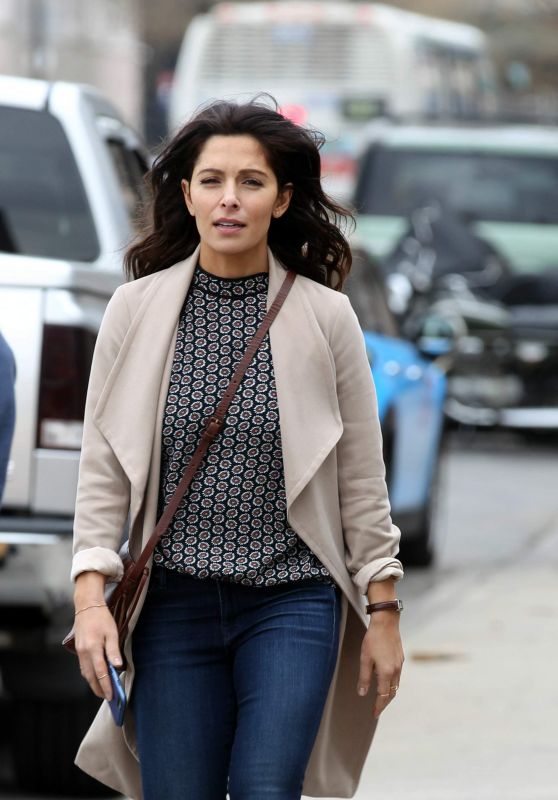
For instance, one of the initial decisions made in casting the new pilot, was to deliberately choose a "diverse" Nancy. While the inclusion of a Nancy of non-white descent was an awesome and progressive choice - and the woman they chose, Sarah Shahi, is a really cool, accomplished actress! - the rest of the casting was coming off as pretty lackluster (ie, predominantly white). To me, it seemed to be less deliberately inclusive casting, and more of a sense of tokenism... and the last thing our Nancy needs is to come off as a gimmick.

Besides, the overall concept for the project was a pretty well-tread and tired one: the series would have followed Nancy as a 30-something detective living and working in New York City... as if television needs another one of those. And if that's not enough to swing you, the cherry on top is this cringe-y character, with a description taken directly from a Variety article on the original casting: "Felix Solis will appear as Lt. Ford, an NYPD lieutenant who finds Nancy's confidence and willingness to stand up and disagree with him unnerving." 

Yikes. Really... after this many police procedurals on television - many of which include women - we still have to write in that kind of an overtly terrible character? 

But beyond television, it's also interesting to note that our fearless female is still a strong Book World presence, with a recent cover release just a couple of years ago for some of her most famous titles. Even beyond print, Nancy's most popular and respected medium so far is one that has her fans at the helm: the line of Nancy Drew video games produced by Her Interactive!

These games are amazing: you play through the eyes of Nancy herself, taking part in both classic capers - like The Secret of the Old Clock - as well as completely new mysteries - like Tomb of the Lost Queen or Shadow at the Water's Edge - and they are chock full of interactive environments, interesting characters, and legitimately suspenseful pacing. They're so popular that they're now numbering into their 30s, and a rabid fan base can be found online. These Nancy fans not only help each other through tricky elements with completed walkthroughs and behind-the-scenes tricks, but also collect game Easter eggs, swap fan art and stories, and, of course, vocalize their love on the Her Interactive Facebook page.

Most recently, the games broke out of their typical format, in order to tackle a new audience: the "Nancy Drew: Codes and Clues" mobile game is built to introduce young Nancy fans to the art of coding, by using her "de-TECH-tive skills" to find who stole the missing tech fair project.

So why is it that we can find so much of a fan base in the video games, while every other multimedia Nancy Drew project seems inevitably doomed to fail? 

From a personal standpoint - as a bit of a superfan - I see a couple of reasons why the games are so much more popular than any other format produced so far. For one, they're deliberately engineered to be relatable, as you literally play throughout the games as Nancy, and what else does a Nancy fan want than to follow in our intrepid teenage sleuth's footsteps, other than walk in them themselves? It tackles that same problem that the original television show had - of everyone already having their own idea of what Nancy looks like - and turns it on its head... because who's to say that Nancy doesn't look just like you?

Additionally, the games continue to find new ways to be innovative and bring in perspectives that entice young girls, just like they did for young women when they were first published in the '30s. While the plotlines and backgrounds that we keep choosing for her big-and-small screen adaptations seem tired before they're even produced, the narratives and stories involved in creating the games are just as interesting as the classic stories, and really push the envelope as to what Nancy can do.

So, while we still seem a long way from solving the mystery of why every Nancy Drew adaptation seems doomed to fail, at least we know we can find our favorite sleuth still growing in popularity online. Maybe it will be some of her newest fans, who will finally figure it out!


Are you a Nancy Drew fan? What do you think about the latest TV news? Have you ever played the Her Interactive games? Let me know, in the comments below!

Tuesday, May 17, 2016

Girls in Space: This Year's Nebula Awards Winners


It's a good day to be a girl who likes science fiction: the results of the 2015 Nebula Awards winners were released this past weekend, and out of the six categories honored, five of the titles belong to female authors!

The sixth, the Ray Bradbury Award for Outstanding Dramatic Presentation - rewarding excellence in science fiction writing for the big screen - went to the writing team behind Mad Max: Fury Road, the Oscar success story and box office bombshell, which revitalized an old franchise with a distinctly feminist slant.

This all marks a pretty notable achievement in the realm of female authors, especially in a genre that is typically gendered for male readers. It might be tempting to shrug this set of authors off as a fluke, but in fact, it marks a distinct shift from prevailing attitudes about what kinds of science fiction are worthy of recognition. 

Don't believe me? Let's check out this year's finalists and winners from two other notable Science Fiction awards: those distributed by Locus Magazine, and the Hugo Awards. 

Locus Magazine - self-described as "The Magazine of the Science Fiction and Fantasy Field" - distributes yearly awards through the Locus Science Fiction Foundation. The finalists were announced on May 3rd, and immediately raised a lot of ire on social media, with plenty of authors - especially those who work in the field of YA - taking to Twitter to voice their dissent.

The problem was, in the YA category - a field dominated by female authors, as well as female readers - not a single female author made it to the list. 

While there might be plenty of women in other categories within Locus' field of recognition, the fact that recent notable YA works that definitely identify under the science fiction and fantasy genres have gone completely unrewarded is a pretty significant slap in the face. Especially after multiple YA authors pointed out that the Locus Award for YA has only ever had 3 women win, yet has had 11 men take the title... with Joe Abercrombie, one of this year's nominees, having won twice already.

Even The Guardian got in on the action, publishing an editorial titled "Have the Locus Awards Been Hit With Myopic Sexism?", which took a balanced approach to explaining the disparity: sure, the YA list was widely unbalanced, but that may be due to the subscribers to Locus, who are responsible for the nominations for and construction of the shortlists. The gender balance in other categories is fair, and many nominations for writers of color have emerged this year, proving that diversity is being held into account. What may be happening, is that older, male readers may not be as familiar with YA authors, and might just be voting for names they recognize. 

However, as Leigh Bardugo - notable YA author of bestselling series like The Grisha Trilogy and Six of Crows -  put it on Twitter, "What's the point of a YA category if you don't see value in authors who write for that market?" 

But beyond Locus, the grand dramatic saga of science fiction recognition continues to be the Hugo Awards, who announced their shortlist midway through this past April.

Once held as one of the highest achievements science fiction and fantasy writing can attain, the Hugoes are now an absolute joke, and its all the result of groups campaigning under the titles of the "Sad Puppies" and the "Rabid Puppies." (While I'm not going to go into any of the history of the melee, I think that most would find this Guardian article as highly explanatory.)

Essentially, the Hugoes are being held captive by campaigns of authors and bloggers who feel that the liberal, leftist tendencies of the field are being unfairly prized over more conservative works. George R. R. Martin hates them; even Alistair Reynolds, one of the authors present on their own selective slates, has said "I do not want their endorsement; I do not want even the suggestion of their endorsement."

And yet, the two parties still prevailed last year in running the awards, with primarily white, primarily male nominees. What resulted was an unprecedented move made by consideration at the Hugoes, where several categories fell to a vote of "No Award," rather than accept any of those on the shortlists. 

Unfortunately, its a new year, and a new slate, with attempts still being made by the "Puppies" factions. (For instance, one of their choices for "Best Dramatic Presentation" consideration this year is an episode of My Little Pony, and one of their selections for "Best Short Story" includes erotica author Chuck Tingle's Space Raptor Butt Invasion.)

What the "Puppies" are attempting this year, however, is a push for already established names and faces within science fiction and fantasy, who just happen to conveniently fit the "Puppies" categories, including Neil Gaiman and Stephen King. As John Scalzi - three time Hugo award winner, most recently for Redshirts, and someone who recused himself from award nomination this year - put it, "The Puppies are running in front of an existing parade and claiming to lead it."

So you can understand why there are plenty of us who are pretty stoked on the winners of the Nebula Awards for this year, where diversity and innovation are getting some well-received recognition. 

I think the best example of why this is all so important to me, is illustrated by the relationships that formed within the Science Fiction Literature class I took last quarter here at the University of Washington.The class itself was full of women... I think that we only had about ten guys total, plus the professor himself. You'd think this gender imbalance would reflect itself in classroom discussion, right?

Unfortunately, no. No matter how many books or morning talk shows can try to tell us to lean into the discussion, it seemed like every voice I heard in that classroom was a male one. While there definitely were women in the class who voiced their opinions and observations, the response to it was primarily to divert it down a different path, or offer a dissenting opinion. By the end of the quarter, the guys had all formed a small pod to the right-hand half of the classroom, where they remained an insular and loud community who talked loudly all through break times about the same things we were discussing in class, unimpeded by those who they felt "had different opinions."

The reason that's in quotes, is because it was their response to some of our more outspoken females  who tried to take part. 

Women are a part of the science fiction - and fantasy! - discussion, now more than ever. Same with those of different cultural, ethnic, and sexual backgrounds. And yet, the continued attitudes of male responses to major awards are excluding important and valuable voices from the discussion, especially in the field of YA. The inclusivity of the Nebula Awards marks an important moment for female scifi fans and authors, but it's not a flash-in-the-pan moment, its a trend with longevity.


What science fiction do you think deserves recognition this year? Would you ever vote in any of these awards? Let me know, in the comments below!